Saturday, August 8, 2026

5-minute office Christmas skit

As the Christmas break draws near, on a designated day, workplace teams gather for what has become an entrenched corporate tradition: the Secret Santa gift exchange. This short Christmas play takes one such typical contemporary scenario, and connects it to the timeless story of Christmas. The message of this play is that it's not the cost of the gift, but the support and bare that we have for each other that matters more.


English version - The Gift That Matters

Download English script


Hindi Version - Jo Dil Se Diya Jaaye

Download Hindi script


Side-by-side English and Hindi version

Download side-by-side English-Hindi script


This play is one which needs minimal props (we did it with just paper shopping bags, cheap small battery lamps, and gift props like a t-shirt and a toy robot). The characteristic of this play is that the performers can understand the gist of each dialog and say it in their own words, even incorporating vernacular languages. In our case, we had the actors switching between English and Hindi, just like conversations naturally flow in Indian offices, and this is why we prepared the side-by-side version of the script. What is critical is to remember the flow of the play, lest the story go off-track!

So take this script and adapt it for your specific workplace, use your inside jokes and references, to let people know the true significance of sharing gifts at Xmas.

Saturday, February 15, 2025

5-minute Christmas skit


As Christmas approaches and the decorations begin to go up, one of the best ways to spread the Christmas spirit is by putting up a Christmas play that tells the story of the nativity of Jesus. Christmas is celebrated by people around the world, but there are a lot of people who do not know the story behind the celebration. The story of Jesus's birth is a beautiful tale of hope, love and divine providence, and enacting it makes the festival meaningful for everyone.

Below is a script for a short Christmas skit. This script presents the main events of the nativity story. The conclusion in particular, explains the relevance of the Christmas message for us today. The script is written for an audience who may be unfamiliar with the story of Christmas, and so keeps things simple. While this skit itself takes just around 5 minutes (or less!), the length and sophistication of the entire performance can be adjusted by including carols, props, lighting and other stage settings. This play is suitable to perform in a school, office, community gathering, or a variety of other contexts.


The Christmas Story - A Light for the World

Download script

Following are some carols that can be sung or played before or after the skit, or at appropriate moments during the skit:

  • Silent night
  • Mary's boy child
  • Joy to the world
  • Hark, the herald angels sing
  • O come all ye faithful
  • Away in a manger
  • O holy night 
  • What child is this
  • Shepherds:
    • Angels we have heard on high
    • The first noel
  • Wise men:
    • We three kings


Copyright info: This script was developed from an initial script written by Fatima Oliver. This script is completely free from copyright restrictions and can be freely downloaded, shared and performed.

Use this script to share the heart-warming story of Christmas with everyone.

Sunday, September 15, 2024

Saint Severus of Vienne

An evangeliser from India to France
Feast day: 8 August 

While native Indian saints like St. Gonsalo Garcia and St. Joseph Vaz who lived in the last 500 years are well known, it would surprise many to hear that there was a native Indian saint back in the fifth century. The Roman Martyrology, the official record of saints of the Catholic church, has this to say about the little-known St. Severus of Vienne: 

'At Vienne, in France, St. Severus, priest and confessor, who undertook a painful journey from India in order to preach the Gospel in that city, and converted a great number of Pagans to the faith of Christ by his labours and miracles.' 

So, who was this man, who traversed deserts and oceans, but was lost in the sands and flowing water of time? Severus was a priest and missionary who evangelised in the city of Vienne in south-east France and constructed many churches. 

Severus was said to be Indian by birth. He was a man of great wealth. His parents died when he was very young. Severus sold his possessions and distributed the money among the poor. Following God's call, he was ordained a priest and travelled to Vienne. At that time, there were still pagans who worshipped false gods and idols in the region. Severus stopped at a place called Vogaria before reaching Vienne. Here, he knocked down a tree dedicated to pagan worship. He found a treasure buried at the foot of the tree. Severus used it to found a chapel in honour of St. Alban (now the church of Saint-Alban-du-Rhône) and he baptised the pagans there. 

Severus settled in Vienne around the year 430. In Vienne, there was a famous temple known as 'The temple of the hundred gods', because it contained the idols of numerous pagan gods. With just a prayer of the saint, the temple fell to the ground. Seeing this, an exceedingly large number of pagans converted to Christianity. This incident is depicted in a stained glass window in the choir of the former cathedral of St. Maurice in Vienne. Severus began the construction of a church dedicated to the protomartyr Stephen at the exact spot where the temple consecrated to pagan idols stood earlier. While digging the earth to quarry stones for the construction, a silver vase, full of coins was discovered. Recognising that this was divine providence, and a sign of confirmation of his mission, Severus gave thanks to God and distributed a part of the money to the poor, and the rest was used for the upkeep of the building and to provide for the needs of the worshipers there. The vase in which the money was found was used at the altar of the church for centuries. 

There is an interesting story about Severus and St. Germanus (c. 378-448), the bishop of Auxerre. Germanus had promised that he would attend the dedication of the church of St Stephen, and when he died, his body was borne through Vienne on the day of the dedication of the church and carried into the church. 

Severus died around the year 455 in Italy, but his body was brought back and buried in the church of St. Stephen, which he had constructed, and which would later take the name of St. Severus. The church was rebuilt at the end of the 11th century and abandoned in the beginning of the 18th century. Its remains are still visible, embedded in a building. Thanks to the work of St. Severus, the last vestiges of paganism in that region were wiped out. The city of Saint-Sève in France is named after Saint Severus of Vienne. St. Severus of Vienne is considered as a saint in the Catholic as well as Orthodox churches, like all other saints prior to 1050.

Saint Severus was a man who did not let his wealth become an obstacle to attaining holiness, and could end paganism by the power of prayer. We can surely count on his intercession to help us stand up to modern-day versions of paganism: materialism and the worship of money. We can also pray for his intercession for the people of his homeland: the Indian sub-continent and its neighbourhood, many parts of which are undergoing crises. Severus' life is a reminder that Jesus was also an Asian, and there is a need to preach his Gospel in Europe too. He will also surely intercede for Indians living in France and Europe. 

In other languages:
French: Saint Sévère de Vienne
Spanish: San Severo de Vienne


(This write-up is mostly based on the references listed in the Wikipedia article on St. Severus.)

The image shows a mereau (token) of the chapter of St. Severus of Vienne, dated 1524, that entitled the bearer to receive food. The token shows St. Severus holding a chained devil in his hand. This is because of an incident when he drove the demons away from a road where they had left a man with no signs of life, and restored the man back to health through his prayers.

Detail of stained glass from the choir of the cathedral of St. Maurice in Vienne depicting St. Severus causing the collapse of the pagan 'pantheon' in Vienne.
Image credit: Denis Krieger, mesvitrauxfavouris.eu
Stained glass by Lucien Bégule dated 1898


An illustration of St. Severus of Vienne from the Facebook and Instagram pages of the Diocese of Grenoble

An impression of St. Severus of Vienne generated by MetaAI (with Llama 3.1). Like the old coin, it shows St. Severus with a chained devil.

Saturday, July 23, 2016

When does night end and day begin?

A wise guru once asked his disciples: "How can we determine the hour of dawn, when the night ends and the day begins?"
One of the disciples suggested: "When from a distance you can distinguish between a dog and a sheep?"
"No," was the answer of the guru.
"It is when one can distinguish between a mango tree and a banyan tree?" asked a second disciple.
"No," the guru said.
"Please tell us the answer then," said the disciples.
"You know the light has come," said the wise teacher, "when you can look into the face of another human being and you have enough light in you to recognize your brother or your sister. Until then it is night, and darkness is still with us."

- earliest known publication with a similar story: Finding My Way Home: Pathways to Life and the Spirit, Henri J. M. Nouwen, 2004

Thursday, July 2, 2015

Konkani Wikipedia launched

It was milestone in the history of literary Konkani when the Konkani Wikipedia came into existence in June 2015; when the efforts of volunteers spread over nearly a decade bore fruit and thus, today there is a functional wikipedia with articles on a wide variety of topics, written from the point of view of Konkani people.
In March 2015, the Wikimedia Foundation, which runs all the Wikipedia sites, approved the Konkani Wikipedia, and the process of creation of the new wikipedia was completed in the end of June 2015. The Konkani Wikipedia project had been started in the 'Incubator', the place where the foundation starts new projects, in 2006. However, initially, there was little progress, and the pace of development only picked up in September 2013 with support from organisations like India Access to Knowledge, Goa University, Nirmala Institute of Education and Dalgado Konknni Akademi.
The Konkani Wikipedia has been assigned the URL:
Here 'gom' is the ISO code for the language that is called Goan Konkani in order to differentiate it from the group of dialects spoken in Maharashtra. This group of dialects have features in common with both the Marathi and Konkani languages, and have been assigned the ISO code knn, and is called as Maharashtrian Konkani.
The new Konkani Wikipedia is a tri-script Wikipedia, with articles in the Devanagari, Latin (Romi) and Kannada scripts. There are around 1000 pages in the Devanagari script, 700 in the Roman script, and 100 in the Kannada script.
Not only the content, but even the interface and menus are available in both the Devanagari and Latin scripts. Although the default script of the Wikipedia interface is Devanagari, users can easily change it to Latin using a language selector feature.
There is also a proposal to develop a script converter, so that articles written in any script can be read in any other, but this is likely to take considerable time. For now, it is time to savour what is probably the moment when Konkani truly enters the online world.

Saturday, April 26, 2014

Saint John Paul II and India map

Here is a nice map that shows some places in India that have something to do with Saint John Paul II. Click on the icons for trivia about the connection to John Paul.


John Paul II had a special love for India and India loved him too. He visited India twice.

Wednesday, February 26, 2014

Translation of a research paper into English

A New Theory for Preparing Models in Order to Analyse Engineering Structures

D. Simoes and Prof. T. A. Jadhav (both affiliated with Sinhgad College, Pune)

Note: This is a translation into English of this research paper

Abstract
In this paper, a new theory for preparing models by using  'finite elements'  is described, in which the integration is performed at the corner points of the element, instead of points in the interior. A user subroutine (UEL) in the Fortran programming language was written in order to test a new formulation in the finite element software Abaqus. Some test cases were analysed and the results were presented.

1. Introduction

I shall begin by explaining how the technique that is known as the 'Finite Element Method' (FEM) was invented years ago:

Figure 1. The invention of FEM


Figure 1 contains an accurate description of FEM, except that I did not invent it.

The way in the equations for calculating the stresses and displacements in an element (i.e. a single rectangle, in this case) are written and simplified is called as the 'finite element formulation'

Ever since research into finite element formulations began in the 1970s, the numerical integration (remember your calculus?) has been performed at some points in the interior of the element, because it's easier that way. However, performing the integration at the corners of the element (called 'nodes') has some advantages of its own and the first descriptions about this approach have been around since around 2000.

There's this awesome software called Abaqus that solves problems based on FEM. It contains element formulations already coded in. In case you're finding life boring and are not satisfied with the mundane, there's a feature known as the 'User ELement' or UEL, that lets you code your own element formulation and make Abaqus use it.

Figure 2. Sometimes when you are bored, one does something challenging, like writing an Abaqus UEL

In this paper we describe a formulation proposed by two awesome-sauce researchers, G. Castellazzi and P. Krysl. We then implement a new type of element, somewhat based on this approach, in Abaqus by writing a user subroutine (UEL).

We assume that the structures we are trying to model follow the Mindlin-Reissner plate theory.

2. Element formulation

After a series of several mind-bending-extremely-complex-equations-that-I-find-difficult-to-understand-myself, we arrive at


Figure 3 explains the indices:

Figure 3. Nodal patch illustrated for various mesh configurations

This, simply put, says that it is possible to approximate the strain at a node, by the weighted average of the strains of all the elements connected to that node, not without a few caveats, disclaimers and exceptions.

3. Abaqus implementation

At this interesting stage, I raise the stakes and put on my programmer's hat above my FEM hat (did you notice the watermelon above the gas cylinder in figure 2?).

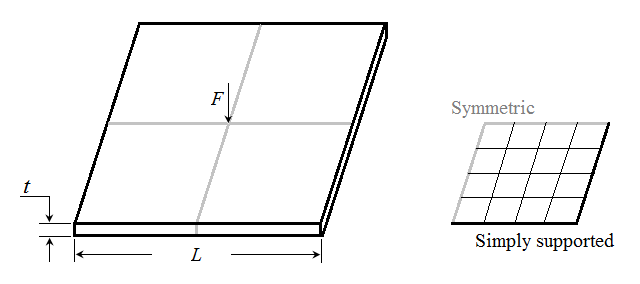
We made several approximations and simplifications in the element formulation to get around the limitations of the Abaqus UEL, and write a FORTRAN code for the element formulation. We then prepared two simple FEM models (figures 4 and 5) and used these two as guinea pigs to try out the element formulation.

Figure 4. Simply supported plate with concentrated load


Figure 5. Clamped strip

4. Results

The table below shows the comparison between the results obtained in the two FEM models using the known formulae for the exact value of the displacement, the inbuilt element formulation in Abaqus, and the formulation that we coded in the UEL.

Table 1. Displacement results of test cases
Test case
Exact displacement
Abaqus inbuilt elements
New formulation UEL
Figure 5. Simply supported plate
0.021138
0.021502
0.014779
Figure 6. Clamped strip
29.468
28.894
24.224

5. Conclusion

As can be seen from the table, our code for the UEL formulation sucks. We would like to shift the blame to the the assumptions made in order to implement in Abaqus UEL, and due to the research being at an initial stage. What other researchers can learn from our mistakes is that Abaqus UEL is not suitable for implementing formulations that involve nodal integrations. To paraphrase Edison, we have not failed to implement this formulation accurately in Abaqus, but we have found one way that won't work. At least we have now learnt more about element formulations and Abaqus than we knew earlier.

Acknowledgements

We would like to thank the helpful people at Faurecia for permitting the use of their resources in order to run some of the simulations. We would also like to thank you, our families and friends who are always there for us. Science rocks, and praise God for that! :)


Wednesday, July 8, 2009

How lucky are you?

Something to ponder:
  • If you have food in the refrigerator, clothes on your back, a roof overhead and a place to sleep, you are richer than 75% of this world.
  • If you woke up this morning with more health than illness, you are more blessed than the million who will not survive this week.
  • If you have money in the bank, in your wallet, and spare change in a dish someplace, you are among the top 8% of the world's wealthy.
  • If you can go to church without fear of harassment, arrest, torture, or death, you are more blessed than three billion people in the world.
  • If you have never experienced the danger of battle, the loneliness of imprisonment, the agony of torture, or the pangs of starvation, you are ahead of 500 million people in the world.
  • Only one in a hundred people receive a college education.
  • Only one in a hundred people own a computer.
  • If you can read this message, you are more blessed than over two billion people in the world who cannot read at all.
As you read this and are reminded how life is in the rest of the world, remember just how blessed you really are!

Wednesday, March 18, 2009

Have you tried everything?

This story is from a sermon preached by a priest in my church. I don't remember which of the priests it was, but this is a thought-provoking story about God's fatherly love for us.

Once, a man bought his son a model train set as a gift. The lad was overjoyed with his new gift. The trains ran on batteries, and when running, the light on the engine lit and smoke came out from the chimney. It even had stations and signals. The boy spent many hours happily playing with the train set, rearranging the tracks in different layouts and making the train start and stop at the stations.

One day, the engine stopped working. The boy was heartbroken. He decided to fix the engine. He brought out his geometry set and tried to repair the engine with his scale, compass, pencil and other instruments. The father was watching his futile attempts. The boy then brought a box of tools and tinkered around with the screwdriver and pliers, but to no avail. By now, the boy was almost in tears.

The man then asked him "Son, did you try using everything you have to repair the train?"

The boy replied "Yes, dad"

"Have you really tried everything?"

"Yes", the boy replied again.

The father then tenderly put his arm around his son and asked him:

"Did you try using me?"

Like the little boy, so many times in our lives, we try to solve our problems ourselves, without asking help from God, our loving and caring Father. God is always ready to help us and will always do what is best for us, if only we trust in Him.

Tuesday, March 17, 2009

Yeh Honsla

This is a song from the soundtrack of the 2006 Hindi film Dor. The music by the Salim-Sulaiman duo is based on Rajasthani folk music.

The lyrics of this song by Mir Ali Hussain are some of the most inspirational and powerful ever, and the poetry is excellent. The lyrics make this song nothing short of an anthem and give it a hymn-like status.

The soulful performance of the song by Shafqat Amanat Ali Khan really moves you if you understand the words. This is one song that motivates me when I'm down.

Here are the lyrics of the song in Hindi:

Yeh Hosla Kaise Jhuke,
Yeh Aarzoo Kaise Ruke?

Manzil Muskil To Kya,
Bundla Sahil To Kya,
Tanha Ye Dil To Kya?

Raah Pe Kante Bikhre Agar,
Uspe To Phir Bhi Chalna Hi Hai,
Shaam Chupale Suraj Magar,
Raat Ko Ek Din Dhalana Hi Hai

Rut Ye Tal Jayegi,
Himmat Rang Layegi,
Subha Phir Aayegi

Hogi Hame Jo Rehmat Adaa,
Dhup Kategi Saaye Tale,
Apni Khuda Se Hai Ye Dua,
Manzil Lagale Humko Gale

Jurrat Sau Baar Rahe,
Uncha Iqraar Rahe,
Zinda Har Pyar Rahe

Here is my translation of the song into English. This is more of an equivalence translation than a literal translation.

How can we be discouraged,
How can this longing cease?

No matter how difficult the goal is,
No matter if the shore is out of sight,
No matter if we’re alone

Even though the path is scattered with thorns,
It still has to be traveled
Even though evening has hidden the sun,
The night must pass someday

This season will end,
We will reap the rewards of our courage,
Morning will come again

When we are blessed,
The sun will shine through the shadows
We pray to our God
That our goal may embrace us

May we dare a hundred times,
May we uphold our pledge,
May every love remain alive

I'm sure you will agree that this is really motivating stuff.


Sunday, March 15, 2009

Tips for life

Please note that I don't necessarily agree entirely with all of these.

  • Remember that great love and great achievements involve great risk.
  • When you lose, don't lose the lesson.
  • Follow the three R's: Respect for self, respect for others and responsibility for all your actions.
  • Remember that not getting what you want is sometimes a wonderful stroke of luck.
  • Don't let a little dispute injure a great friendship.
  • When you realize you've made a mistake, take immediate steps to correct it.
  • Spend some time alone every day.
  • Open your arms to change, but don't let go of your values.
  • Remember that silence is sometimes the best answer.
  • Live a good, honorable life. Then when you get older and think back, you'll be able to enjoy it a second time.
  • A loving atmosphere in your home is the foundation for your life.
  • In disagreements with loved ones, deal only with the current situation. Don't bring up the past.
  • Share your knowledge. It's a way to achieve immortality.
  • Be gentle with the earth.
  • Once a year, go some place you've never been before.
  • Remember that the best relationship is one in which your love for each other exceeds your need for each other.
  • Approach love and cooking with reckless abandon.
  • Give people more than they expect. Do so cheerfully.
  • Memorize your favorite poem.
  • When you say, "I love you," mean it.
  • When you say, "I'm sorry," look the person in the eye.
  • Never laugh at anyone's dreams. People who don't have dreams don't have much.
  • Love deeply and passionately. You might get hurt but it's the only way to live life completely.
  • In disagreements, fight fairly. No name calling.
  • Don't judge people by their relatives.
  • Talk slowly, think quickly.
  • When someone asks you a question you don't want to answer, smile and ask, "Why do you want to know?"
  • Say "bless you" when you hear someone sneeze.
  • Smile when picking up the phone. The caller will hear it in your voice.
  • Pray. There's immeasurable power in it.
  • Don't trust a man/woman who doesn't close his/her eyes when you kiss.
  • If you make a lot of money, put it to use helping others while you are living. That is wealth's greatest satisfaction.
  • Remember that your character is your destiny.

Sunset on Mars


On May 19th, 2005, NASA's Mars Exploration Rover Spirit captured this stunning view as the Sun sank below the rim of Gusev crater on Mars. This Panoramic Camera (Pancam) mosaic was taken around 6:07 in the evening of the rover's 489th martian day, or sol. Spirit was commanded to stay awake briefly after sending that sol's data to the Mars Odyssey orbiter just before sunset. This small panorama of the western sky was obtained using Pancam's 750-nanometer, 530-nanometer and 430-nanometer color filters. This filter combination allows false color images to be generated that are similar to what a human would see, but with the colors slightly exaggerated. In this image, the bluish glow in the sky above the Sun would be visible to us if we were there, but an artifact of the Pancam's infrared imaging capabilities is that with this filter combination the redness of the sky farther from the sunset is exaggerated compared to the daytime colors of the martian sky. Because Mars is farther from the Sun than the Earth is, the Sun appears only about two-thirds the size that it appears in a sunset seen from the Earth. The terrain in the foreground is the rock outcrop "Jibsheet," a feature that Spirit has been investigating for several weeks (rover tracks are dimly visible leading up to "Jibsheet"). The floor of Gusev crater is visible in the distance, and the Sun is setting behind the wall of Gusev some 80 km (50 miles) in the distance.

This mosaic is yet another example from MER of a beautiful, sublime martian scene that also captures some important scientific information. Specifically, sunset and twilight images are occasionally acquired by the science team to determine how high into the atmosphere the martian dust extends, and to look for dust or ice clouds. Other images have shown that the twilight glow remains visible, but increasingly fainter, for up to two hours before sunrise or after sunset. The long martian twilight (compared to Earth's) is caused by sunlight scattered around to the night side of the planet by abundant high altitude dust. Similar long twilights or extra-colorful sunrises and sunsets sometimes occur on Earth when tiny dust grains that are erupted from powerful volcanoes scatter light high in the atmosphere.

Goan with the Wind - Rajdeep Sardesai

Goan with the Wind

Article by Rajdeep Sardesai on IBNLive. 21 March 2008

In the early 1990s, Air India printed a calendar showcasing people from different states in their traditional costumes. The Goa portrait had a couple at a church wedding in bridal finery: the lady in a flowing gown, her partner in a jacket and tie. The publication sparked off protests within the Goan community, who accused the national carrier of portraying a flawed image of the state. 

In a state where over sixty per cent is Hindu, the calendar was seen to reinforce the stereotype of Goa as a "westernised" Portuguese enclave. Ironically, the protests were led, among others, by the redoubtable architect Charles Correa, a Goan Catholic proud of his Saraswat Brahmin heritage, someone who was perfectly comfortable in his kurta pajama and Kolhapuri chappals. The protestors were successful enough to force a change in the calendar. 

When the Air India Maharajah gets it wrong, what chance does the average Indian have of getting Goa right? 

For decades now, Goa has been the victim of a rather perverted caricature: the stereotypical image of the state has been of a lazy, fun-loving coastal community with a weak moral core. Bollywood, often the trailblazer in setting cultural trends, did Goa no favours: the majority of Hindi cinema showed the Goan as the drunk Anthony Gonsalves-like character, a woman on one arm, a whisky bottle bottle in his pocket. Even the otherwise well made Dil Chahta Hai created the idea of Goa as the ultimate fantasy of the young Indian: girls were easy, sexual freedom guaranteed with the puritanical streak of the rest of the country absent here. 

Rewind to the original "Goan" film, Bobby in the 1970s: find me a Goan fisherman's daughter who dresses in skimpy bikinis and shorts like Dimple Kapadia and I will buy you a villa next to Vijay Mallya's seaside bungalow in Candolim. 

Unfortunately, it hasn't been easy to shake off the "live the good times" image of Goa, especially when the mainstream media has lapped it up so easily. If a few years ago, it was fish, feni and football that was considered to be the limit of Goa's vision, its now sex, sin and sand, courtesy the Scarlett Keeling controversy. For an increasingly tabloidish media, the Scarlett controversy is manna from heaven. 

A teenage white woman drugged, drowned, possibly raped, perhaps murdered, on a beach in Goa by mysterious shack owners: what more can a carnivorous media ask for? Especially when there are enough close up pictures of a semi-nude Scarlett with marks all over her body, suggesting foul play and a possible cover up? That the area where the incident took place is notorious for drug peddling, that Scarlett herself appears to have had an active sex life, that the girl's truant mother has a past history of crime, and is now embellishing her public remarks with unsubstantiated allegations against Goa's top politicians, that Goa's netas and local cops have a terrible record in fighting crime, can the media really then be blamed for seeing this as a sensational crime story which will catch restless eyeballs? 

But Scarlett's story is not simply another whodunit, nor does it fit in within the "fight for justice" framework that in the aftermath of the Jessica Lal case seems to have become the new war cry for a section of the media. Instead, the Scarlett saga lies at the heart of a more abiding conflict between diverse cultural strands of Goa: between licentiousness and piety, between new world normlessness and old world certitudes. 

There is the Goa of the beachcombers, of the hippies who discovered Baga in the early 70s, of the rave parties, of paedophilia, of decadent hedonism. But there is also the Goa of deep social conservatism, of folk religiosity in its village temples and churches, of simplicity of lifestyle within rural communities, of a premium on education and of immense pride in its plural, multi-cultural heritage. The Goa of a tiny strip of beach between Candolim and Anjuna is constantly in the media gaze and makes front page headlines. The vast majority of Goans who live outside this world are rarely documented because their lives seem much too unexciting to be explored. Historians and anthropologists have done much to unravel the "real' Goa, but for the national media, it is so much easier to reduce an entire people to a tourist brochure . 

Indeed, Goa's tourism industry - earning the state approximately 10,000 crores in foreign exchange per annum -- has been at the heart of the modern-day mythification of the state as some form of a sexual paradise. It is estimated that around 25 lakh tourists come to Goa each year, a vast majority of them local tourists, eager to explore the "idea" of being in a "free" state, free from the restrictions of middle class attitudes. Only a fifth of the tourists who visit the state each year are foreigners, most of them looking for a cheap holiday. The Caribbean is too expensive, the Costa del Sol not exotic enough and Australia too far: so why not clamber onto a chartered plane to a land of the "carnival"? 

Unfortunately, the postcard image of Goa often has little connection with the living reality of its people The result is a clash of cultures that has partly shaped the debate over the Scarlett issue. 

For many Goans, the foreign tourist is a needless intrusion into their community life . Even now, the idea of any form of nudity on the beaches offends Goans, at times even the sight of a half clad gent on a bike troubles villagers. Which perhaps explains why very few Goans seem to have any sympathy for Scarlett's mother, shocked as they are by her decision to leave her teenage daughter behind and travel to neighbouring Karnataka on her own. The Keelings' behaviour offends Goan sensibilities, it reopens lingering fears of a traditional society being overrun by the "outsider". That a young girl might have been raped and murdered by locals doesn't seem to concern a majority of Goans as much as it should. 

And yet, the real threat to Goa's cultural identity does not lie in the lifestyle of the tourist, confined as they are to a small stretch of the state. In fact, in a state with limited employment opportunities, Goa needs to attract more, not less tourists. 

The critical threat to Goan society instead comes from within: from the brazen sale of priceless real estate to those who have little stake in the state's future . It isn't the influx of tourists which should trouble Goans as much as the growing influence of the builders and construction agents who appear determined to destroy the state's environmental treasure in violation of all existing laws. While Goa's politicians go into cataclysms over the Scarlett case, how many of them have bothered to raise their voice against the virtual auction of the state to land sharks? Is it any surprise that in a state which has seen as many as 19 chief ministers in 21 years of statehood, politicians have lost the moral authority to speak up on the issues of governance that really matter to the average Goan? 

Frankly, the challenge before Goa today is not the one which is being posed by a Scarlett-afflicted media: a permissive drugs and drink culture might make for good television, its not central to Goa's impending identity crisis. 

The real challenge for Goans is whether they can preserve the uniqueness of their land by ensuring that it doesn't become another concrete jungle. Environment may not make sensational headlines like a murder can, but in the long run, preventing environmental degradation can alone secure Goa's future. 

Post-script: Let me also debunk another stereotype: the "desai" in my surname often leads people to presume I am Gujarati. The fact is that my father was a Goan, and I am proud to be one too.


Starry Night over the Rhone - Vincent van Gogh


Starry Night over the Rhone
Vincent van Gogh, 1888
Oil on canvas
72.5 cm × 92 cm (28.5 in × 36.2 in)
Musée d'Orsay, Paris

This is how Vincent described it:
Included a small sketch of a 30 square canvas - in short the starry sky painted by night, actually under a gas jet. The sky is aquamarine, the water is royal blue, the ground is mauve. The town is blue and purple. The gas is yellow and the reflections are russet gold descending down to green-bronze. On the aquamarine field of the sky the Great Bear is a sparkling green and pink, whose discreet paleness contrasts with the brutal gold of the gas. Two colourful figurines of lovers in the foreground.

Rainy evening - Leonid Afremov


Leonid Afremov is a Belarus born, Israeli modern painter who creates unique landscapes, cityscapes and figures using a palette knife rather than a brush to paint.

"I tried different techniques during my career, but I especially fell in love with painting with oil and pallette-knife. Every artwork is the result of long painting process; every canvas is born during the creative search; every painting is full of my inner world. Each of my paintings brings different mood, colors and emotions. I love to express the beauty, harmony and spirit of this world in my paintings. My heart is completely open to art. Thus, I enjoy creating inspired and beautiful paintings from the bottom of my soul. Each of my artworks reflects my feelings, sensitivity, passion, and the music from my soul. True art is alive and inspired by humanity. I believe that art helps us to be free from aggression and depression."

~ Leonid Afremov

A Child's Angel

 A Child's Angel 
by Emma Bombeck

Once upon a time, there was a child ready to be born.

One day She asked God:

"They tell me you are sending me to earth tomorrow but how am I going to live there being so small and helpless?"

God: "Among the many angels, I chose one especially for you. She will be waiting for you and will take care of you."

Child: "But tell me, here in Heaven, I don't do anything else but sing and smile, and that's enough for me to be happy. Will I be happy there?"

God: "Your angel will sing for you and will also smile for you every day. You will feel your angel's love and be happy."

Child: "How am I going to be able to understand when people talk to me if I don't know the language that they talk?"

God: "Your angel will tell you the most beautiful and sweet words you will ever hear. With much patience and care, your angel will teach you how to speak."

Child: "And what am I going to do when I want to talk to you?" 

God: "Your angel will place your hands together and will teach you how to pray."

Child: "I've heard that on earth there are bad men. Who will protect me?"

God: "Your angel will defend you even if it means risking her own life."

Child: "But I will always be sad because I will not see you anymore."

God: "even though I will always be with you, your angel will always talk to you about me and will teach you the way to come back to me. "

At that moment there was much peace in Heaven, but voices from earth could already be heard. The child, in a hurry, asked softly:

"Oh God, if I am about to leave now, please tell me my angel's name."

God: "Your angel's name is of no importance. You will call your angel ... Mommy."

A Meadow Lark Sang


The child whispered, "God, speak to me"
And a meadow lark sang.
The child did not hear.

So the child yelled, "God, speak to me!"
And the thunder rolled across the sky
But the child did not listen.

The child looked around and said,
"God let me see you" and a star shone brightly
But the child did not notice.

And the child shouted,
"God show me a miracle!"
And a life was born but the child did not know.

So the child cried out in despair,
"Touch me God, and let me know you are here!"
Whereupon God reached down
And touched the child.

But the child brushed the butterfly away
And walked away unknowingly.

Unknown

Keynote post


Okay, ladies and gentlemen, here is my keynote first post. I will briefly outline what this blog is about. In this blog, I will post inspirational and heart-warming articles, stories and fables (chicken-soup type). I will also post some quotes I like. I will post some of my favourite beautiful artwork (photos, paintings, drawings, sculptures, etc, by anyone). I also intend to post some interesting anecdotes and news clips (sort of like Sherlock Holmes' case-books). Thus, this blog will become a repository of wisdom and creativity. There will not be much original work by me here, so don't expect any confessional-style stuff here, nor will this be a diary. I will not assume ownership of any of the material I copy and paste (or rather copy and post) here.